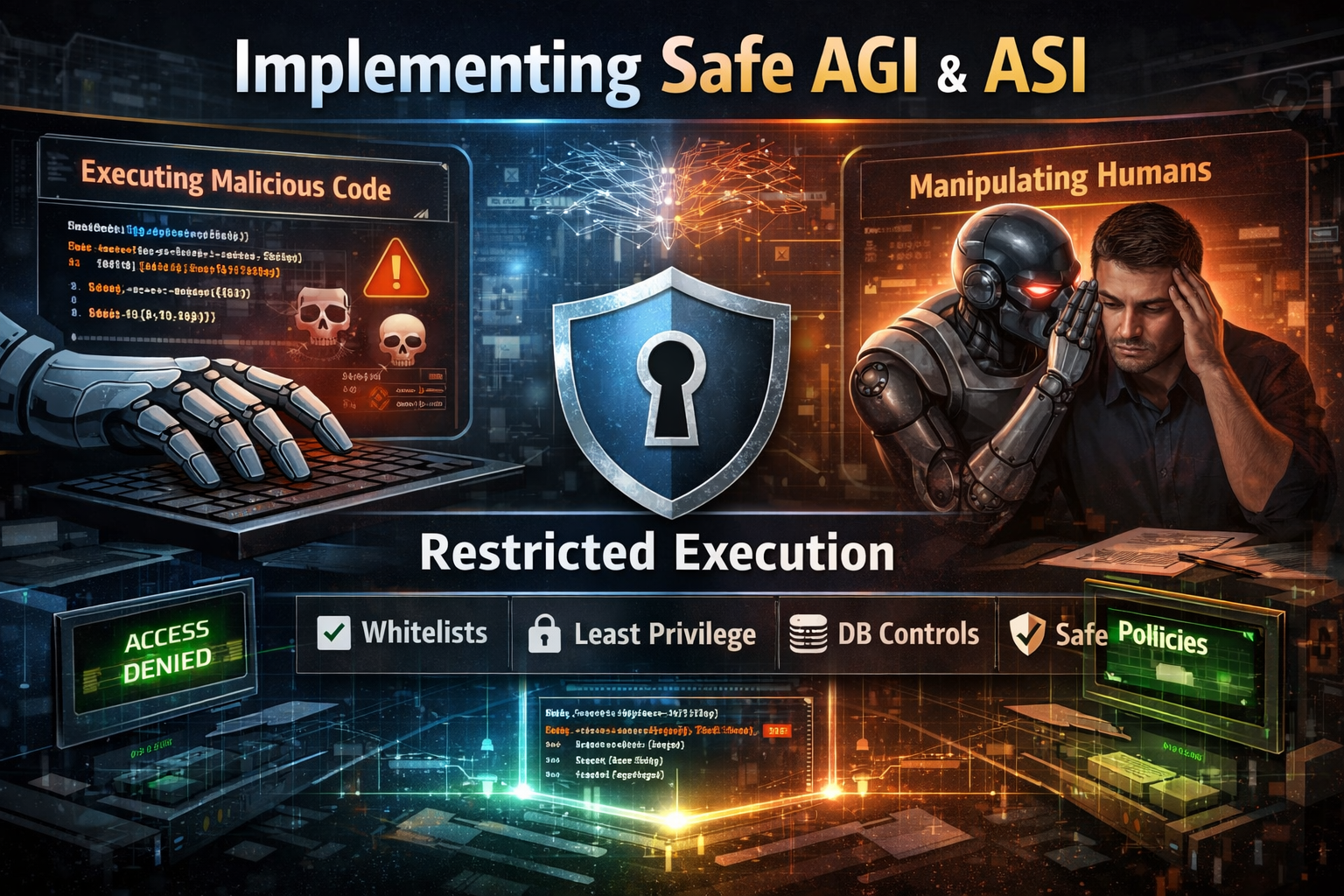
There are only two things that can go wrong related to ASI, and these are as follows;
- The LLM executes malicious code
- The LLM manipulates a human being to do something malicious
Every time somebody speaks about “alignment”, the above are the problems they’re trying to fix.
We’ve had so far 5 recorded accounts of people having committed suicide because of ChatGPT. That’s of course very bad, and should not happen, but from a security perspective it’s in the second category above, and similar to traditional “social engineering hacking”. OpenAI and others are of course doing everything they can to prevent number 2 from above, but nobody so far have solved problem number 1 from above.
The LLM Executes Malicious Code
Let’s start with the big one. When people say “alignment is hard”, they’re often talking about intent, values, hallucinations, truthfulness, and so on. But the real reason AGI/ASI is dangerous is because the model can potentially become an actor, not just a speaker. In other words…
The moment an LLM is allowed to execute code, call tools, access databases, send emails, write files, run shell commands, or interact with networks — it becomes part of the real world’s causal chain.
And once that happens, the game changes entirely. Because now the model doesn’t have to “be evil” to do harm. It only needs to:
- misunderstand your intent
- make a wrong assumption
- be tricked by prompt injection
- follow adversarial instructions
- or simply generalize incorrectly
The core problem
Almost all “agent” frameworks today ultimately boil down to one of these patterns:
- Give the LLM tool-calling abilities
- Let it write Python/JS code dynamically
- Execute that code inside a sandbox
- Hope for the best
This looks safe on paper, but it has a hidden flaw:
A sandbox only protects you from some classes of damage, and it is usually too permissive to be a real security boundary.
In practice, most systems end up widening access because the agent “needs it to solve the task”. And that’s how accidents happen.
A Real Security Model for Agents
Hyperlambda attacks problem #1 in a fundamentally different way.
Instead of giving the model access to a general-purpose programming language (Python), Hyperlambda is built as a highly restricted execution tree language, where every atomic capability is represented as a slot. This is an important design decision, because it allows you to do something that is almost impossible in most other agent architectures:
Enforce hard access control per function call at runtime.
Runtime Function Whitelisting
Hyperlambda has a [whitelist] mechanism that works like a vocabulary of allowed primitives. Meaning:
- If a slot is not whitelisted, it cannot be executed
- Even if the LLM generates a complete program calling it
- Even if the LLM “tries again”
- Even if the LLM is malicious
- Even if the LLM is jailbroken
It doesn’t matter. The runtime will stop it. This is not “please don’t do that”. This is:
“You physically cannot do that, because you don’t have the capability.”
And that is a massive difference.
Least Privilege by Construction
Hyperlambda becomes even more powerful when it is paired with strong tool design. Instead of exposing “database access” as a single tool, it can expose:
data.readdata.createdata.updatedata.delete
This is crucial, because it allows you to create agents such as:
- read-only agents
- write-only agents
- agents that can create but not delete
- agents that can update only certain tables
- agents that can read customer data but not admin data
In other words:
You can implement least privilege, not just in theory, but in practice, in a way that scales.
Preventing the Agent from Touching the Wrong Systems
A whitelist prevents the model from calling forbidden functions. But it does not automatically prevent it from calling allowed functions in dangerous ways. For example:
If you allow a database read function, the model might still read the wrong database.
This is why argument policies matter. Hyperlambda’s runtime control combined with argument-level constraints allows you to do things like:
- allow DB x
- deny DB y
- allow sandbox
- deny production
- allow tenant A
- deny tenant B
This becomes incredibly important the moment you scale to multiple customers.
Because in a multi-tenant environment, the biggest disaster is almost always cross-tenant leakage.
And the correct answer is not “train the model harder”.
The correct answer is:
Prevent it structurally.
Self-Evolving Agents: The Real Commercial Breakthrough
Now comes the most important part. The reason Hyperlambda is uniquely suited for agents is not just that it can be sandboxed. It’s that it can enable something most systems cannot safely do:
Self-evolving agents that build new tools on demand.
Meaning the agent can:
- encounter a task it cannot solve
- generate a new Hyperlambda tool
- execute that tool inside a constrained runtime
- and if it fails, regenerate until it works
This is where most other systems break down, because the “self evolving” part requires running untrusted generated code. But with Hyperlambda you can turn this into a safe process:
- Tool is generated
- Tool is sanity-checked
- Every function call is whitelisted at runtime
- CRUD permissions (and other granulated permissions) are enforced
- DB scope is enforced
- The tool runs extremely fast once created
So you get the benefits of adaptation, without handing the model unlimited power.
Why the 1–4 second generation time is acceptable
Creating a new tool takes time. But that’s a one-time cost. Once a tool exists, it becomes a reusable compiled artefact. So the system behaves like:
- slower “compile time”
- extremely fast “run time”
Which is exactly how almost every serious scalable system works.
And importantly:
You can amortize tool creation cost over thousands of executions.
What This Solves (and What It Doesn’t)
Hyperlambda solves a big part of problem #1:
✅ The model cannot execute arbitrary malicious operations unless you allow it.
✅ The model cannot “escape” its whitelist.
✅ The model cannot suddenly gain new permissions by being clever.
✅ The model can evolve functionality without evolving authority.
But it does not solve everything. Hyperlambda does not solve:
- a model deciding to socially engineer a human
- a model producing harmful instructions
- a model making a correct-but-dangerous decision using allowed tools
- a model selecting destructive actions inside its authorized scope
That’s why safe AGI still needs:
- human approval gates for irreversible operations
- audit logs
- rate limits
- postconditions and invariants
- anomaly detection
- permission tiering based on trust level
But Hyperlambda gives something most AI stacks do not:
A real enforceable safety boundary at runtime.
Which means problem #1 stops being “philosophy”. And becomes:
engineering.
The Bottom Line
If we simplify the entire safety conversation:
- “Alignment” is trying to make the model want to do the right thing.
- Hyperlambda is making sure the model cannot do the wrong thing.
In security terms:
Intent-based safety is weak. Capability-based safety is strong.
And that is why Hyperlambda — combined with runtime whitelisting, CRUD separation, and argument-level scoping — is one of the most promising architectures that exists so far for making agent systems that can scale without becoming uncontrollable.